
The Vertical Revolution: Inside the $8 Billion Battle for Our Stolen Focus
The cinematic experience was once defined by grand scale—massive screens, surround sound, and a shared, public audience. But as we move through 2026, the industry is reckoning with a reality that seemed like a punchline only five years ago: the most valuable real estate in entertainment is now 6.1 inches tall and held in one hand.
The intertwining of technology and storytelling has moved beyond a "partnership" and into a total biological merge. We are no longer just consuming content; we are living in a continuous, vertical loop of fragmented narratives.
The Quibi Autopsy
To understand why we are here, we must look at the $1.75 billion crater left by Quibi.
A play on the words “quick bites”, Quibi was a short-lived streaming service that offered high-budget, movie-quality shows in 10-minute episodes designed exclusively for mobile viewing. Despite raising nearly $2 billion in funding, the platform failed to find an audience and shut down just six months after its April 2020 launch.
On paper, Quibi’s idea—high-quality, short-form content for mobile—was exactly what current market leaders are doing today. However, Quibi suffered from a "Hollywood Ego" problem. They attempted to force prestige standards, like A-list stars and $100,000-per-minute budgets, onto a medium that values speed and raw dopamine over cinematic polish.
While Quibi was trying to make Westworld in ten-minute chunks, current market leaders like ReelShort and DramaBox realized that mobile users actually wanted addictive, "snackable" content—often campy revenge or romance stories that mimic the high-frequency hooks of a TikTok feed.
Furthermore, Quibi’s technical choices were its own undoing. By famously disabling screenshots and social sharing at launch to protect its "prestige" IP, it effectively cut itself off from the digital town square. In the mobile age, if a piece of media isn't meme-able or shareable, it doesn't exist. This was compounded by a rigid subscription model that ignored how mobile users actually spend money.
Unlike Quibi’s flat monthly fee, today's winners use micro-transaction logic borrowed from mobile gaming. Users are often willing to pay $0.50 to see "just one more" episode of a cliffhanger, frequently spending far more than a standard Netflix subscription without the psychological barrier of a large upfront cost.
The New Titans of the Attention Economy
The transition to mobile-only entertainment represents a massive reallocation of capital. The "scarcity of attention" has become the primary bottleneck of the digital age. As consumers become more selective and price-sensitive with traditional "Big Streamers" (OTT growth is projected to cool to just 5% in 2026), they are flocking to micro-drama apps.
| Market Metric | 2025-2026 Forecast & Data |
|---|---|
| Global Micro-Series Revenue (2026 Prediction) | $7.8 Billion (Deloitte) |
| Short Drama App Revenue (Q1 2025) | ~$700 Million (3x YoY growth) |
| U.S. Share of Global Revenue | ~49% in 2025 |
| Mobile App Downloads (Projected 2025) | 300+ Billion |
| App Store Consumer Spending (Q1 2025) | ~$40 Billion |
This has birthed new giants: ReelShort and DramaBox each reported quarterly revenues exceeding $120 million in early 2025, with a cumulative global revenue for the category reaching nearly $4 billion.
This gold rush has forced established companies to pivot. Disney+ has officially phased out the standalone Hulu app to merge content into a more engagement-heavy single interface, while Netflix and Amazon are increasingly investing in "network-friendly" procedurals and live sports—content that is easy to fragment into social-media-friendly clips.
TikTok has quietly launched PineDrama, a standalone app dedicated exclusively to micro-dramas, signaling that the format has matured from "in-feed content" to a standalone product category. Even traditional publishers like Time and The New York Times have introduced vertical "Bytes" or "Watch" tabs, treating vertical video as defensive infrastructure against the creator economy.
In the current landscape, approximately 40% of all mobile app usage is dominated by social media and entertainment, vastly outperforming productivity and communication categories, which struggle to maintain the same levels of daily session frequency.
| Market Metric (2025-2026) | Data Point |
|---|---|
| Short Drama App Revenue (Q1 2025) | ~$700 Million (3x YoY growth) |
| Global Consumer App Spend | ~$223 Billion (2026 Projection) |
| Daily Mobile Time Spent (Avg) | 4 hours 37 minutes |
| Entertainment & Social Time Share | ~68% of total mobile screen time |
The economic split reveals a winner-take-all battle for attention. While productivity and utility apps (like Google Sheets or Notion) generate billions in revenue, they account for only 13.6% of user time. In contrast, social and entertainment apps command over two-thirds of all mobile sessions.
This disparity is driving a "Gold Rush" of new startups; Y Combinator’s 2025-2026 cohorts are filled with AI-native entertainment firms like Martini (collaborative filmmaking) and Eggnog (an "AI YouTube" for consistent characters), all aiming to replace the traditional studio model with agile, algorithmic production.
The Psychological Cost: A Culture in "Stolen Focus"
While this shift is an economic triumph, the human cost is becoming impossible to ignore. In his work Stolen Focus, Johann Hari argues that our ability to pay deep attention is being actively "predated" by platforms designed to keep us scrolling. The vertical drama is the logical extreme of this design. It eliminates "stopping signals"—the natural pauses like the end of a chapter or the rolling of credits—replacing them with an "infinite scroll" that exploits what psychologists call unit bias, where the brain feels compelled to finish a "unit" of content that technically never ends.
The Neural Tax of High-Frequency Hooking
The physiological impact is measurable through the lens of modern neuroscience. Research into "Digital Dopamine" suggests that the rapid-fire pacing of micro-dramas bypasses the prefrontal cortex—the seat of executive function—in favor of the amygdala. This results in:
The Dopamine Deficit State: Dr. Anna Lembke, professor of psychiatry at Stanford University and author of Dopamine Nation, notes that repeated exposure to high-frequency digital stimuli leads to a "dopamine deficit state." This creates a physiological "come down" that triggers anxiety and restlessness when the stimulus is removed. In clinical terms, the brain over-corrects for the dopamine spike by tilting toward the "pain" side of the pleasure-pain balance.
The "Popcorn Brain" Phenomenon: Coined by David Levy of the University of Washington, this describes a mental state where the brain is so accustomed to the rapid-fire multitasking of digital feeds that the slower pace of offline life becomes unstimulating. A JAMA Network Open study (2025) suggests that short-form video consumption is increasingly linked to decreased sustained attention spans in adolescents.
The Zeigarnik Loop: By utilizing the Zeigarnik Effect, these apps keep the brain in a state of "cognitive itch." As long as the cliffhanger remains unresolved, the brain maintains mental tension that can only be resolved by clicking "Next Episode."
Parallels in the "Dopamine Economy"
The vertical revolution parallels the evolution of the gambling industry. Modern short-form apps utilize Variable Ratio Reinforcement, the same psychological architecture used in Las Vegas slot machines. Natasha Dow Schüll, author of Addiction by Design and Associate Professor at NYU, identifies this as "the machine zone"—a state of suspended animation where the user loses track of time, space, and even bodily awareness.
The Developmental Toll
The World Health Organization's Global Initiative on Digital Health (GIDH) has raised concerns regarding the transition from a "play-based" childhood to a "phone-based" one. Data indicates that the intimacy of the vertical format—focused almost entirely on high-emotion close-ups—creates a "parasocial surrogate" for real interaction.
"We are essentially experiencing a 'human downgrade'," notes the Center for Humane Technology. "When technology exploits our Paleolithic emotions (like the need for social validation and narrative closure) with god-like speed, it creates a gap between our biological capabilities and our digital reality."
In 2012, prolific British film critic Mark Kermode published his book The Good, the Bad, and the Multiplex. In it, he describes his personal philosophy of what the traditional theatrical experience is and how it contrasts with modern digital viewing habits:
"Cinema is a deep cathedral of the soul; it is a place where we go to be overwhelmed, to look up at images that are larger than ourselves in a darkness that is shared. To take that experience and shrink it down into the neon corridor of a mobile phone—interrupted by pings, surrounded by the glare of the mundane world—is not just to change the format; it is to lose the very essence of what cinema is."
Culturally, we are moving toward "disposable" narratives. We are trading the "deep cathedral" of the cinema for the "neon corridor" of the smartphone—a transition that may leave us with a wealth of content, but a poverty of sustained attention.
The AI Frontier: From Hallucination to Simulation
The fusion of Generative AI and the vertical drama industry is no longer a futuristic theory; in 2026, it is the primary engine of content production. This integration represents a double-edged sword that promises to democratize creativity while simultaneously threatening the very fabric of shared human culture.
The Positive Catalyst: Democratization and Personalization
From a production standpoint, AI has effectively "collapsed the value chain."
Hyper-Localization: According to Deloitte’s 2026 TMT Predictions, AI-powered dubbing and "visual translation" (where AI adjusts an actor's lip movements to match a new language) have allowed micro-dramas to launch globally in 50+ languages simultaneously. This has turned local creators into global moguls overnight.
The "Niche" Explosion: AI allows for the creation of content so specific it was previously economically impossible. We are seeing the rise of "Prompt-to-Series" platforms where a user can request a specific sub-genre—for example, "Cyberpunk Regency Romance"—and an AI agent generates a 10-episode vertical arc in minutes, tailored to that user’s specific visual preferences.
Production Efficiency: Morgan Stanley (2025) reports that GenAI can reduce production costs in TV and film by up to 30%, but in the micro-drama space, that figure is closer to 60%. This allows small indie studios to compete with the "Big Streamers" by producing high-fidelity visuals without a Hollywood-sized crew.
The Negative Friction: Synthetic Culture and "Truth Decay"
However, the societal costs of an AI-saturated entertainment diet are profound.
The Infinite Filler: As noted by the Nieman Journalism Lab (2026), we have entered an era where "content" has become functionally infinite. When machines can out-produce humans by a factor of a million, the "signal-to-noise" ratio collapses. This leads to "Attention Spread," where our focus is so thinly distributed across synthetic filler that we lose the capacity for "earned judgment."
Algorithmic Homogenization: UNESCO (2025) warned that because AI models are trained on existing datasets, they tend to reinforce cultural biases and "flatten" storytelling into a safe, predictable average. This creates a feedback loop of "sameness," where every drama follows the exact same emotional beats designed by an algorithm to keep you from "churning."
The Erosion of Authenticity: As AI becomes better at simulating human emotion, we face a crisis of trust. When a vertical drama features a "human" actor who is actually an AI avatar, the parasocial relationship—the feeling of connection the viewer has with the performer—is fundamentally hollowed out. This contributes to what researchers call "Automated Credibility," where we can no longer tell if the emotion we are consuming was felt by a person or calculated by a processor.
Much of this research suggests that the deep cultural fracture of 2026 is not human versus machine, but instead the battle between earned judgment and automated credibility.
As entertainment becomes increasingly "simulated" rather than "filmed," society faces a choice: embrace a world of hyper-personalized, infinite dopamine, or find ways to protect the "human reporting" and lived experiences that machines cannot replicate.
Choosing the Architect of Our Attention
The "Vertical Revolution" is not merely a change in screen orientation; it is a fundamental restructuring of the human experience. As we stand in 2026, we find ourselves at a digital crossroads where the convenience of a fast-food dopamine loop threatens to permanently replace the slow-cooked nourishment of deep, intentional storytelling. While the economic and technological triumphs of this era are undeniable, they come with a hidden tax on our collective cognitive sovereignty.
The Path to Digital Mindfulness
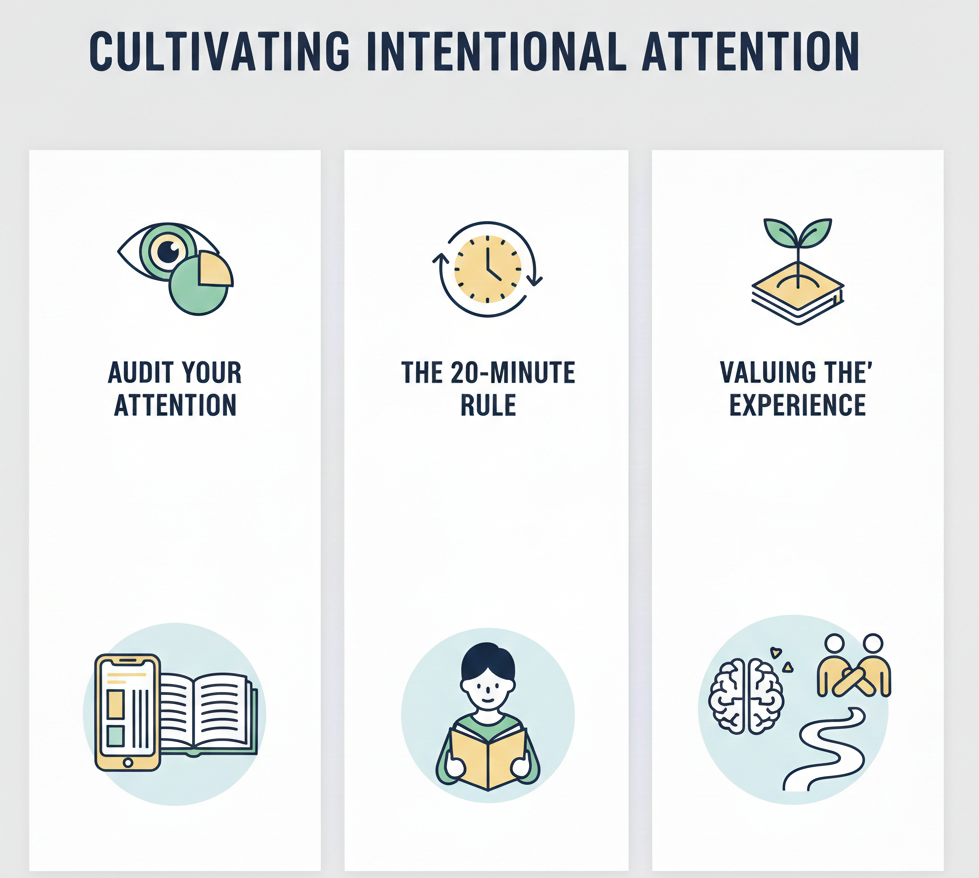
The era of passive consumption must end. To navigate this landscape, we must shift our relationship with our devices from one of compulsion to intention. Readers should pause to consider: Is your entertainment a choice, or a reflex? To protect our "stolen focus," we must re-establish the "mental guardrails" that algorithms have worked so hard to erase. This requires a conscious audit of our attention, recognizing when we are trading the long-term rewards of a sustained narrative for the hollow, fleeting satisfaction of an infinite scroll.
Some ways to start:
Audit Your Attention: Periodically tracking the ratio of "snackable" vertical content versus long-form, sustained narrative.
The 20-Minute Rule: Committing to twenty minutes of deep focus—whether a book, a film, or a hobby—without a secondary screen, to recalibrate a "popcorn brain."
Valuing the "Earned" Experience: Recognizing that the friction of a slow-burn story is often where the most profound human connection resides.
Shifting the Course: A Better Future
Fortunately, a counter-movement is gaining momentum as society recognizes the "human downgrade" caused by predatory design. A new wave of cognitive ergonomics is being championed by regulators and organizations like the Center for Humane Technology, which advocates for "transparency in persuasion." These initiatives aim to mandate disclosures for apps using variable ratio reinforcement—the same psychological mechanics used in slot machines—effectively giving users a "nutrition label" for digital addiction. By forcing platforms to reveal the hidden levers they pull, we can begin to return agency to the individual.
Parallel to these legal shifts, a cultural movement is emerging to protect the sanctity of human expression. The Human Artistry Campaign, a coalition of over 150 organizations including the RIAA and the Recording Academy, is leading the charge for "Human-First" standards. They champion the principle that AI should support, not replace, human creativity, pushing for clear provenance and watermarking to ensure lived experience remains a premium over algorithmic filler.
Furthermore, developers are now building Mindful OS layers—interfaces designed to treat attention as a finite resource. Companies like Siempo and Freedom pioneered this space, and by 2026, major players like Apple and Google have integrated deeper "Focus" and "Digital Wellbeing" features that act as "digital exit ramps." These systems use AI not to keep us scrolling, but to help us close the app once our specific entertainment needs are met, rather than when our willpower finally breaks.
The vertical loop may be infinite, but our time is not. As the line between creator and machine blurs, our most valuable asset remains our sustained attention. By choosing to look up from the 6.1-inch screen, we don't just save our focus—we save our ability to experience a world that is far wider and more complex than a curated feed.
Works Cited
Books
Haidt, Jonathan. The Anxious Generation: How the Great Rewiring of Childhood Is Causing an Epidemic of Mental Illness. Penguin Press, 2024.
Hari, Johann. Stolen Focus: Why You Can’t Pay Attention—and How to Think Deeply Again. Crown, 2022.
Lembke, Anna. Dopamine Nation: Finding Balance in the Age of Indulgence. Dutton, 2021.
Schüll, Natasha Dow. Addiction by Design: Machine Gambling in Las Vegas. Princeton University Press, 2012.
Kermode, Mark. The Good, the Bad and the Multiplex: What’s Wrong with Modern Movies? Arrow Books, 2012.
Journal Articles & Research Papers
Chiencharoenthanakij, Romteera, et al. "Short‐Form Video Media Use Is Associated With Greater Inattentive Symptoms in School-Age Children: Insights From a Cross-Sectional Survey." Brain and Behavior, vol. 15, no. 7, July 2025, e70656. PMC12230358.
Dhillon, Siena Sanjana, et al. "The Relationship Between the Use of Short Form Videos on Social Media and the Attention Span of Students." International Journal of Scientific Research (IJSR), vol. 4, no. 10, October 2025.
Levy, David. "The Impact of Technology on the Average Human Attention Span: The 'Popcorn Brain' Phenomenon." Information School, University of Washington, 2011/2016 Update.
Institutional Reports & Industry Data
Center for Humane Technology. "The Ledger of Harms: The Impact of High-Engagement Content on Human Cognition." San Francisco, CA, 2024.
Deloitte. "TMT Predictions 2026: The Rise of Micro-Series and the Fragmented Content Landscape." Deloitte Insights, 2025.
World Health Organization (WHO). "Global Initiative on Digital Health (GIDH): Strategic Objectives for National Digital Health Transformation 2020–2027." Geneva, Switzerland, 2025.
Morgan Stanley. "The Economics of Generative AI in Media and Entertainment: 2025 Sector Analysis." Global Research, 2025.
Nieman Journalism Lab. "The Infinite Feed: Content Overload and the Collapse of Shared Narratives." Harvard University, 2026.
UNESCO. "Artificial Intelligence and the Diversity of Cultural Expressions: 2025 Global Report." United Nations Educational, Scientific and Cultural Organization, 2025.
World Economic Forum (WEF). "The Future of Information: Truth Decay and the Rise of Synthetic Media." Digital Economy Series, 2025.